Heart rhythm disorders are not always present during a medical consultation. Some abnormalities occur intermittently, sometimes lasting only a few seconds, a few minutes, or even appearing several days later.
When a standard electrocardiogram (ECG) or a 24- to 48-hour Holter monitor fails to document symptoms, prolonged monitoring of the heart’s electrical activity may be necessary.
This type of monitoring provides valuable information about heart rate, rhythm regularity, the possible presence of electrical pauses, and other rhythm abnormalities. It can assist in the investigation of several clinical situations, including:
palpitations“Palpitation” is a symptom related to an abnormality in heartbeats. There are several types of arrhythmias. This term is like a surname that encompasses several first names. not documented by routine testing
dizziness or syncope (loss of consciousness) of unknown cause
certain strokes whose origin has not been clearly identified
Before discussing the various monitoring devices available, it is useful to briefly review some fundamental concepts.
The Heart’s Electrical System and Its Recording
The heart acts as a muscular pump that circulates bloodBlood is composed of red blood cells, white blood cells, platelets, and plasma. Red blood cells are responsible for transporting oxygen and carbon dioxide. White blood cells make up our immune defense system. Platelets contribute to blood throughout the body. Each heartbeat is triggered by an electrical impulse that travels through a specialized conduction network. This mechanism normally produces a regular rhythm whose rate adapts to the body’s needs during activity and rest.
The electrical signals generated by the heart can be detected using small sensors placed on the skin, called electrodes. These signals are then displayed as a graphical tracing. This is the principle behind the electrocardiogram (ECG), a fundamental cardiology test that has been used for many years.
However, a conventional ECG records cardiac activity for only a few seconds.
Some electrical abnormalities occur only occasionally and may not be captured during this brief period. Their detection may therefore require prolonged monitoring using different methods.
Recording can be performed:
over a very short period (a few seconds, as with a standard ECG)
over 24 to 48 hours (Holter monitor)
over much longer periods, depending on the device used
Two Types of Long-Term Monitoring
Several systems are available to record the heart’s electrical activity over extended periods.
These devices may be:
external, when they are worn on the skin
internal, when a small monitor is implanted beneath the skin
These two approaches address different clinical needs depending on symptom frequency and the likelihood of detecting a rhythm abnormality.
This section focuses on external skin-mounted devices, that is, monitoring systems applied directly to the surface of the chest.
Different Approaches to External Cardiac Monitoring
Several devices are now available to record the heart’s electrical activity over extended periods.
They can be grouped into three main categories:
Continuous electrode-based monitoring devices
Symptom-activated monitoring devices
Smartwatches and personal connected devices
1. Continuous Electrode-Based Monitoring Devices
General Principle
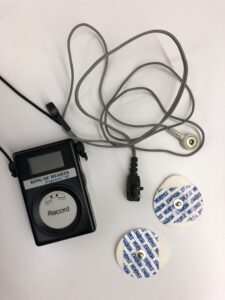
These devices use adhesive electrodes placed on the chest. The electrodes are connected to a small recorder that monitors the heart’s electrical activity for several days or sometimes several weeks.
The principle is similar to that of a Holter monitor, but the recording period is longer.
This extended monitoring increases the likelihood of documenting rhythm abnormalities that occur only occasionally.
Among the best-known examples are King of Hearts–type devices and other systems based on the same principle.
Scheduling an Appointment
A medical prescription is required to obtain this type of device. A request is sent to the appropriate service, and an appointment is scheduled for installation.
The date and time are usually communicated by telephone or mail.
On the Day of Installation
No special preparation is usually required. Fasting is generally not necessary.
However, it is recommended to bring an up-to-date list of medications.
Device Installation
During the appointment, small adhesive electrodes are attached to the skin of the chest. These electrodes detect the heart’s electrical activity and transmit it to a recording device.
To ensure optimal recording quality:
the area may be shaved if there is significant chest hair
moisturizing creams should not be applied to the chest before installation
Daily Activities While Wearing the Device
The electrodes are connected by wires to a small recorder. Depending on the model, it may be worn on a belt or carried using a shoulder strap.
Most normal daily activities can generally be continued during the monitoring period.
Symptom Activation
A button on the recorder allows the user to place a marker whenever palpitations“Palpitation” is a symptom related to an abnormality in heartbeats. There are several types of arrhythmias. This term is like a surname that encompasses several first names., dizziness, or other symptoms occur.
This feature helps correlate symptoms with the electrical activity recorded at that exact moment.
To preserve recording capacity throughout the prescribed monitoring period, activation is generally reserved for significant symptoms.
Symptom Diary
Keeping a brief diary noting the date, time, and nature of symptoms can be very helpful.
This information allows physicians to compare reported symptoms with the recorded data.
Hygiene and Temporary Removal
Replacement electrodes are usually provided.
Depending on the device, it may sometimes be removed temporarily for personal hygiene and then reinstalled afterward.
These devices are generally not water-resistant. However, it is preferable to keep the system connected as much as possible to maximize the diagnostic value of the examination.
Returning the Device
The return date is provided at the time of installation.
It is important to respect this deadline, as these devices are generally reused for other patients.
Once the analysis has been completed, the results are sent to the physician who prescribed the test. A copy may also be forwarded to another physician upon request.
Advantages
Extended recording over several days or weeks
Ability to document infrequent rhythm abnormalities
Correlation between symptoms and the electrical tracing
Non-invasive technique
Compatible with most daily activities
Limitations
Presence of electrodes and wires throughout the monitoring period
Temporary removal required for certain water-related activities
Possible skin irritation in some individuals
Very rare abnormalities may remain undetected despite prolonged monitoring
The device must be returned before the analysis can be performed
2. Symptom-Activated Monitoring Devices
This approach is particularly useful when symptoms occur infrequently or unpredictably.
Unlike continuously worn systems, these devices record the heart’s electrical activity only when activated by the user. They can therefore document episodes of palpitations“Palpitation” is a symptom related to an abnormality in heartbeats. There are several types of arrhythmias. This term is like a surname that encompasses several first names., dizziness, or discomfort as they occur.
Two commonly used examples are the Cardiomemo and the KardiaMobile.
Cardiomemo
The Cardiomemo is a portable device used to record the heart’s electrical activity only when symptoms occur.
Scheduling an Appointment
A medical prescription is required to obtain this type of device. A request is sent to the appropriate service, and an appointment is scheduled for installation.
The date and time are usually communicated by telephone or mail.
On the day the device is provided
Unlike devices that use adhesive electrodes, no permanent chest installation is required. During the appointment, the patient is given a small device that can be carried at all times.
When palpitations“Palpitation” is a symptom related to an abnormality in heartbeats. There are several types of arrhythmias. This term is like a surname that encompasses several first names., dizziness, or discomfort occur, the device is simply placed against the chest to record the heart’s electrical activity during the episode.
Symptom Diary
Keeping a brief diary noting the date, time, and nature of symptoms may help facilitate interpretation of the recordings during analysis.
Returning the Device
Because the device is provided on a temporary basis, a return date is established when it is issued.
After analysis, the results are sent to the physician who prescribed the test. A copy may also be forwarded to another healthcare professional upon request.
Advantages
No wires or electrodes need to be worn continuously
Easy to carry
Simple to use when symptoms occur
Particularly useful when episodes are infrequent
No prolonged attachment of a device to the chest
Limitations
Recording occurs only when the device is activated
Arrhythmias that do not cause symptoms will not be detected
The device must be readily available when symptoms occur
Recording quality may be slightly lower than that obtained with continuously worn electrodes
KardiaMobile
The KardiaMobile is a personal device that can be purchased directly by the user.
Unlike the Cardiomemo, which is typically provided temporarily by a clinic or healthcare facility, the KardiaMobile belongs to its owner and can be used for as long as desired.
How Does It Work?
The device contains metal sensors that record the heart’s electrical activity when the fingers are placed on them.
The recording is transmitted to an application installed on a smartphone. It can be viewed, stored, or shared with a healthcare professional.
The recording generally corresponds to a single ECG lead.
Advantages
Available immediately after purchase
Can be used repeatedly over many years
Easy to carry
Recordings can be stored for future reference
Tracings can be easily shared with a physician
Provides a degree of independence for the user
Limitations
Records only when activated
Asymptomatic abnormalities may go undetected
Analysis is limited to a single ECG lead
Requires a compatible smartphone
Purchasing the device involves a personal expense
Any interpretation must be confirmed by a healthcare professional
3. Smartwatches and Cardiac Electrical Monitoring
Wearable technologies have evolved rapidly in recent years in the field of vital sign monitoring.
Certain smartwatches can now measure heart rate and, depending on the model, other parameters such as bloodBlood is composed of red blood cells, white blood cells, platelets, and plasma. Red blood cells are responsible for transporting oxygen and carbon dioxide. White blood cells make up our immune defense system. Platelets contribute to blood oxygen saturation and bloodBlood is composed of red blood cells, white blood cells, platelets, and plasma. Red blood cells are responsible for transporting oxygen and carbon dioxide. White blood cells make up our immune defense system. Platelets contribute to blood pressure. Many also offer more advanced heart rhythm monitoring features, including the recording of a simplified electrocardiogram (ECG).
These technologies have helped democratize the detection of certain heart rhythm disorders, particularly atrial fibrillation.
How Do They Work?
Smartwatches generally use two different methods of cardiac monitoring.
-Heart Rate Measurement
The watch uses an optical sensor that projects light through the skin to analyze variations in blood flow.
This method allows continuous monitoring of heart rate at rest, during exercise, and while sleeping.
-Electrocardiogram (ECG) Recording
Some models can also generate a simplified electrical tracing of the heart.
To obtain this recording, the user generally places a finger on the watch crown or on a dedicated sensor. Some devices can also automatically initiate a recording when an irregular heart rhythm is detected.
The resulting tracing can then be viewed on a smartphone and shared with a healthcare professional.
Heart Rate or ECG: What Is the Difference?
It is important to distinguish between measuring heart rate and recording the heart’s electrical activity.
Heart rate simply refers to the number of heartbeats per minute. This information indicates how fast the heart is beating but does not allow a detailed analysis of the heart rhythm itself.
An electrocardiogram, on the other hand, directly records the heart’s electrical activity. It provides information not only about heart rate but also about rhythm regularity and certain rhythm abnormalities.
The tracing obtained from a smartwatch generally corresponds to a single ECG lead.
For comparison, a standard medical electrocardiogram uses 12 leads, representing 12 different viewing angles of the heart’s electrical activity recorded simultaneously.
A smartwatch therefore provides useful information, but it is more limited than a conventional ECG.
What Can Smartwatches Contribute?
These devices can offer several advantages:
opportunistic screening for certain heart rhythm irregularities
documentation of episodes of palpitations“Palpitation” is a symptom related to an abnormality in heartbeats. There are several types of arrhythmias. This term is like a surname that encompasses several first names.
personal monitoring for some individuals at increased risk
greater awareness of cardiovascular health
They may help detect certain intermittent arrhythmias at an earlier stage.
The information collected can also help healthcare professionals better understand symptoms that are sometimes difficult to describe or document during a medical consultation.
Important Limitations
Despite their advantages, smartwatches have several limitations.
They do not replace a standard medical electrocardiogram.
The ECG obtained is limited to a single lead.
Certain arrhythmias may go undetected if no recording is made.
False-positive results can occur and may generate unnecessary concern.
Any interpretation must be confirmed by a healthcare professional.
These devices are primarily tools for screening and documenting symptoms. They can complement a medical evaluation but do not replacea consultation or a specialized examination.
Conclusion
The choice of monitoring method depends on several factors, including the nature of the symptoms, their frequency, and the clinical context. The healthcare professional will recommend the most appropriate approach to maximize the likelihood of documenting the suspected abnormality.
Thanks to advances in technology, it is now possible to monitor the heart’s electrical activity for much longer periods than in the past. These various monitoring approaches play an important role in the diagnosis of many heart rhythm disorders and help guide treatment decisions.