Environmental cardiology studies the impact of our living environment on heart health. For a long time, we have known that certain factors increase the risk of heart disease. They are usually classified into two categories:
Non-modifiable factors: age, male sex, family history.
Modifiable factors: smoking, sedentary lifestyle, excess weight, diabetes, high bloodBlood is composed of red blood cells, white blood cells, platelets, and plasma. Red blood cells are responsible for transporting oxygen and carbon dioxide. White blood cells make up our immune defense system. Platelets contribute to blood pressure.
Today, another element is added to the list of modifiable factors: the environment in which we live. This factor directly influences cardiovascular health.
Environmental Impact
The globalization of information now allows us to track, almost in real time, statistics on cardiovascular disease and deaths worldwide.
When comparing data from one region or country to another, we sometimes see striking differences: why, for example, are residents of a certain area more often affected by cardiovascular disease? Why are there more (or fewer) deaths?
These differences can largely be explained by two factors: eating habits and the environment. These links are now well documented and deserve closer examination.
Major Differences in Cardiovascular Mortality Between Countries
A few years ago, the World Health Organization (WHO) published striking data: among men aged 25 to 64, the cardiovascular mortality rate in Russia and Ukraine was 11 times higher than in Switzerland and Spain.
Such a gap cannot be explained solely by traditional risk factors.
Traditional Risk Factors… and Newcomer
Well-known risk factors include heredity, smoking, diabetes, high cholesterolCholesterol is essential for the proper functioning of the human body, but it can also have harmful effects if present in excess. >>, high bloodBlood is composed of red blood cells, white blood cells, platelets, and plasma. Red blood cells are responsible for transporting oxygen and carbon dioxide. White blood cells make up our immune defense system. Platelets contribute to blood pressure, excess weight, and a sedentary lifestyle.
For a long time, medicine focused on these family and individual aspects. Today, another player is increasingly taking the stage: the environment.
Industrial Revolutions and Waves of Mortality
Looking back through history, we see that cardiovascular diseases were far less common before the industrial era. Between 1900 and 1950, for example, the number of heart attacks in the United States quadrupled, while remaining low in non-industrialized regions.
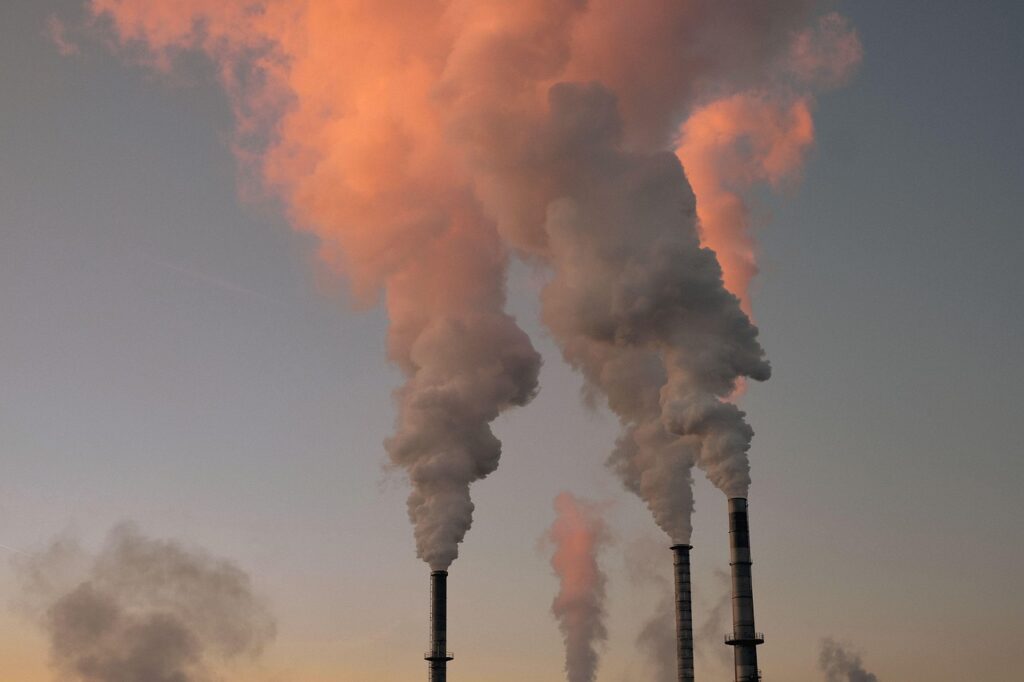
Each industrial revolution has been followed by a wave of cardiovascular mortality, largely driven by three environmental factors:
Airborne nano-aggressors: microscopic pollutant particles in the air, invisible to the naked eye, that can penetrate deep into the lungs and enter the bloodstream.
Foodborne nano-aggressors: certain industrial additives or contaminants that, when consumed regularly, disrupt the functioning of the heart and bloodBlood is composed of red blood cells, white blood cells, platelets, and plasma. Red blood cells are responsible for transporting oxygen and carbon dioxide. White blood cells make up our immune defense system. Platelets contribute to blood vessels.
Urban mineralization: the gradual disappearance of green spaces in favor of concrete, which leads to less physical activity, more summer heat, and poorer air quality.
Air Pollution: A Major Culprit
In March 2014, the WHO reported that air pollution is responsible for 7 million deaths per year worldwide — one in every eight deaths.
We often think of developing countries, but industrialized nations are also affected.
For example, in 2008, in Canada, an estimated 20,000 additional deaths were attributed to air pollution, at a healthcare cost of $9.1 billion.
Excess Deaths: Understanding the Calculation
The term excess deaths refers to the number of deaths above what would normally be expected in a population affected by heart disease. To calculate this figure, we first estimate how many people would be expected to die, on average, based on the number of patients and the usual mortality rate for that condition.
Example:
If a cardiovascular disease has an annual mortality rate of 5%, then for 1,000 affected individuals, we would expect about 50 deaths per year. If, in the same year, 75 actual deaths are observed, we speak of 25 excess deaths.
These 25 additional deaths are a signal that there may be one or more contributing factors — such as pollution, extreme heat, or other environmental elements — that are worsening the situation.
Oxidative stress and inflammation: a harmful duo for the heart
The mechanisms by which air pollutants can trigger a heart attack, a stroke, or even sudden death are now well documented. Two key phenomena are involved: oxidative stress and the inflammation it causes.
To simplify the concept of oxidative stress, imagine that each cell in our body has tiny “power plants.” While producing energy, they also release unwanted by-products called free radicals — much like a power station that also emits smoke. Normally, our body has protective shields called antioxidants, which neutralize these free radicals.
The problem arises when the production of free radicals exceeds the antioxidants’ defense capacity. This imbalance damages cells and sets off a chain reaction: inflammation, dysfunction of bloodBlood is composed of red blood cells, white blood cells, platelets, and plasma. Red blood cells are responsible for transporting oxygen and carbon dioxide. White blood cells make up our immune defense system. Platelets contribute to blood vessels, clot formation… all of which increase the risk of serious cardiovascular events.
Improving Air Quality: Victories… but a Long Road Ahead
In 2014, Montréal and Toronto experienced their first summer without smog since records began. Researchers at the University of Toronto estimated that this improvement reduced excess deaths linked to pollution (1,300 versus 1,700 in 2004) and hospitalizations (3,550 versus 6,000). This success was attributed in part to the closure of coal-fired power plants and Ontario’s “Drive Clean” program.
A similar advance was seen in the 1980s when lead was removed from gasoline. Atmospheric concentrations dropped so much that Montréal’s Air Quality Monitoring Network (RSQA) no longer measures them.
However, the current context shows that the fight is far from over.
The summer of 2025 saw a significant deterioration in air quality in Montréal and Toronto due to wildfires in the north and west of the country. On some days, these two cities ranked among the most polluted in the world.
Historically, only one in three days in downtown Montréal has an Air Quality Index (AQI) rated as “good” (AQI < 25). Moving from “good” to “fair” air quality (AQI 25–50) is not trivial: a Harvard study found that this shift alone increases the risk of stroke by 35% to 50%.
Food Pollution: Another Invisible Aggressor
Alongside airborne nano-aggressors from fossil fuels, our daily lives are also filled with dietary nano-aggressors, mainly in the form of industrial additives.
Among the many substances introduced into our food supply, some are particularly harmful: excessive and widespread salt, trans fats, and industrially added sugars. Regular consumption of these ingredients triggers a cascade of problems — high bloodBlood is composed of red blood cells, white blood cells, platelets, and plasma. Red blood cells are responsible for transporting oxygen and carbon dioxide. White blood cells make up our immune defense system. Platelets contribute to blood pressure, lipid imbalances, metabolic syndrome (a pre-diabetic state), obesity — all of which open the door to heart attacks and strokes.
This is compounded by a marketing environment that makes these products hard to avoid: a child will be exposed to around 30,000 junk food ads before reaching adulthood. While vending machines selling sugary drinks in schools are gradually being removed, the proliferation of fast-food outlets near everyday living spaces still fuels the problem. Public health recommendations often struggle to gain traction against this reality.
Air Pollution and Diet: A Multiplying Effect
When air pollution and industrial junk food act together, the result is a “perfect vascular storm.” Studies are unequivocal: experiments have shown that mice exposed to both a high-fat, fast-food-type diet and polluted air develop massive atherosclerotic plaques in their arteries.
In other words, air pollution and industrial diets don’t just add up — they amplify each other, multiplying cardiovascular risks.
Urban Concrete Environments
Urban areas are expanding and becoming increasingly “mineralized,” meaning that natural surfaces are being replaced with materials like concrete and asphalt. These surfaces trap heat, limit water infiltration, and reduce green space. This process encourages the formation of urban heat islands, spikes in smog, less vegetation-based air filtration, and problems with runoff and drainage.
In these greenery-depleted settings, heat accumulates and lingers, challenging the body’s ability to regulate temperature.
How the Body Regulates Temperature
To understand the impact of heat on the body, we can compare the human body to a cooling system: an air conditioner draws in indoor heat and expels it outside using a pump, fluid circulation, and a fan.
In humans, the brain’s thermoregulatory center (the hypothalamus) acts as a thermostat, maintaining internal temperature around 37 °C (98.6 °F).
Under heat stress — when ambient temperatures exceed the body’s natural compensating ability — the heart works faster to increase bloodBlood is composed of red blood cells, white blood cells, platelets, and plasma. Red blood cells are responsible for transporting oxygen and carbon dioxide. White blood cells make up our immune defense system. Platelets contribute to blood flow to the skin. The skin acts as a heat exchanger, dissipating heat through vasodilation (increased bloodBlood is composed of red blood cells, white blood cells, platelets, and plasma. Red blood cells are responsible for transporting oxygen and carbon dioxide. White blood cells make up our immune defense system. Platelets contribute to blood flow at the surface) and sweating (evaporation of sweat).
This mechanism helps stabilize body temperature but puts additional strain on the heart, especially during heat waves, physical exertion, or in people with cardiovascular disease.
In large cities, the abundance of concrete and asphalt worsens the situation: these materials store heat during the day and release it at night, prolonging thermal stress.
For vulnerable individuals, these adaptation mechanisms can quickly reach their limits — which explains why heat waves are a major cardiovascular risk in highly built-up urban areas.
The Shocking Impact of Heat Waves in France: Past Data and Present Reality
In August 2003, France faced a major public health crisis. Extreme temperatures caused more than 20,000 excess deaths, particularly in urban areas with little vegetation.
The impact was so severe that Parisian morgues were overwhelmed, and bodies had to be stored in industrial freezers. This episode even led, for the first time since World War II, to a drop in life expectancy in the country, highlighting the urgent need to address urban heat islands.
From the 2003 Shock to Subsequent Years
This event served as a wake-up call, prompting authorities to implement national heatwave plans, strengthen health surveillance, and develop adaptation strategies. Despite these measures, extreme heat remains a formidable threat.
Heat Waves Still Claiming Lives
Since 2015, heat waves have continued to cause several thousand deaths each year in France and across Europe. The summers of 2022 and 2023 rank among the deadliest since 2003, with record temperatures and a particularly strong impact in urban areas lacking greenery.
The increasing frequency and intensity of these episodes, amplified by climate change, confirm that prevention and adaptation are more essential than ever.
Importance of Green Spaces
Awareness of the scale of deforestation — with half of the world’s forests already gone — has highlighted the essential role trees play in our living environments. In both urban and rural areas, they contribute to visual harmony, psychological and physical well-being, climate regulation, reduced building energy costs, and air purification by capturing and transforming pollutants.
Numerous studies confirm the health benefits of tree cover. One large-scale study in Scotland, involving 40 million UK residents, found that within just five years, the greenest areas saw a 6% reduction in cardiovascular mortality — across all social classes.
Three main mechanisms explain these benefits:
Lower air pollution in green spaces
Better air filtration and purification thanks to trees
A direct biological effect of certain proteinsProteins are fundamental components manufactured by the cells of our body. They play an essential role in many biological functions, acting as hormones, antibodies, and even cholesterol transporters, among others. >> produced by vegetation on the human body
Link with Environmental Cardiology
These findings show that green spaces are not merely an urban aesthetic concern — they have a measurable impact on heart and vascular health. Environmental cardiology emphasizes that the environment in which we live directly influences our cardiovascular risk.
Protecting and developing green areas thus becomes a preventive measure on par with combating smoking, physical inactivity, or poor diet. In this way, health arguments align with climate change objectives: fewer fossil fuels and more trees — for the planet and for the heart.
Hospitals: Care Providers and Role Models
As major players in public health, hospitals can play a key role not only through the care they deliver but also through their commitment to a healthier environment.
This is the idea behind the “green hospital” concept. Increasingly, attention is being paid to the environmental footprint of buildings, to reducing pollutants, and to adopting sustainable solutions.
The Government of Québec’s broader mandate requires all ministries and agencies to adopt strategies to reduce greenhouse gas (GHG) emissions and other pollutants, while applying the “3Rs” — reduce, reuse, recycle.
Hospitals, which account for roughly 2% of national GHG emissions, are directly involved in this effort.
Health Tree Day
An inspiring example is Health Tree Day, launched in 2008 at Cité de la Santé Hospital in Laval and now held in Sherbrooke, Val-d’Or, Trois-Rivières, and Lanaudière — an idea that’s catching on!
On this day, small trees or shrubs are planted on hospital grounds — whether in gardens, landscaped areas, adjoining green spaces, or even in parking lots.
The event demonstrates how healthcare institutions can combine care, prevention, and environmental responsibility, while reminding us of the close links between a healthy environment and cardiovascular health.
Individual Actions, Collective Impact
Despite occasional political or administrative setbacks, it is up to hospital administrators and physicians to integrate this knowledge into their decisions, joining the efforts of governments and businesses.
Every individual action strengthens the collective momentum. Think globally, act locally.